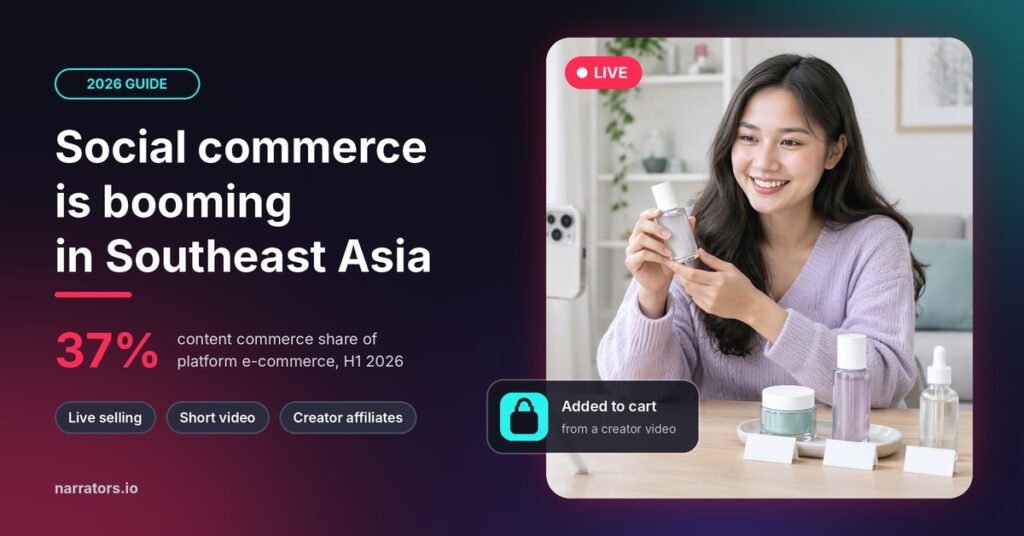
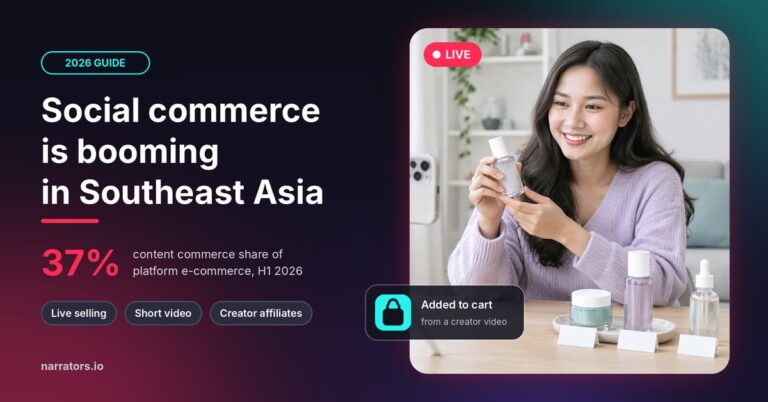
Social commerce is booming in Southeast Asia, and 2026 is the year it went mainstream. Content commerce now accounts for 37% of the region’s platform e-commerce value, nearly double its share in 2024. In just eight months, Meta put shopping links inside Reels, YouTube launched video commerce tools built for the region, and TikTok gave TikTok Shop an app of its own, launched first in Singapore, Malaysia, Thailand and the Philippines.
This guide covers what changed, who is driving the sales, and how to build your social commerce strategy for 2027.
Key takeaways
- Content commerce, meaning sales driven by live, short video and creator affiliates, is on track to reach USD 77.9 billion in Southeast Asia in 2026.
- TikTok, YouTube and Meta all launched new tools this year to make creator content shoppable.
- Creators influence most purchase decisions in the region, and professional live sellers have become a fast-growing force.
- The strongest strategies combine creators who build demand with features and talent that convert it.
Social commerce in SEA in 2026: the numbers
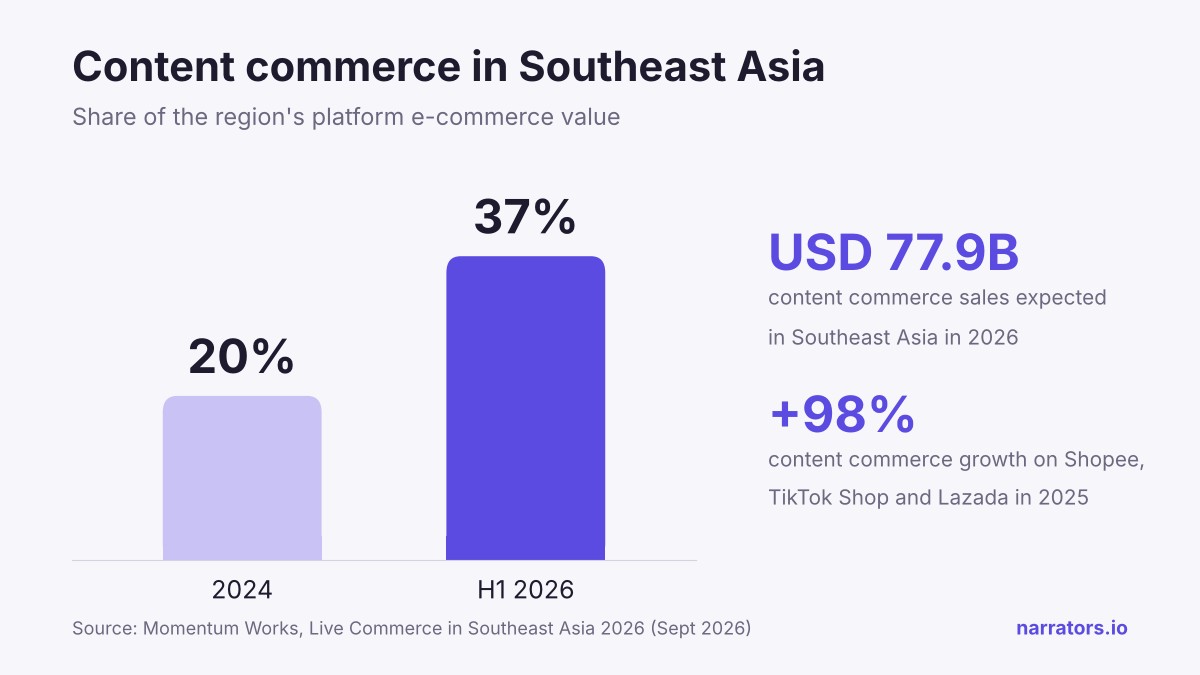
The scale of the shift is clear in two recent studies. Momentum Works’ Live Commerce in Southeast Asia 2026 report, released in September 2026, found that:
- content commerce made up 37% of Southeast Asia’s platform e-commerce value in the first half of 2026, up from 20% in 2024;
- the region is on track to reach USD 77.9 billion in content commerce sales in 2026;
- content commerce on Shopee, TikTok Shop and Lazada combined reached USD 49.7 billion in 2025, up 98% year on year.
Shoppers confirm the trend. Cube Asia’s E-commerce Influencer & Affiliate Marketing in Southeast Asia 2026 report, released in July 2026 and covering Singapore, Malaysia, Indonesia, Thailand, Vietnam and the Philippines, found that 67% of respondents said influencers and creators influenced their purchases, mainly by sparking interest in a product, while 39% discovered products through creators and 51% used them to research before buying. The report projects influencer marketing will account for 8% of the region’s e-commerce sales in 2026, worth about USD 18 billion.
What the platforms are building
The three platforms brands use most for creator campaigns all moved this year to bring the checkout closer to creator content.
TikTok: a shopping app of its own
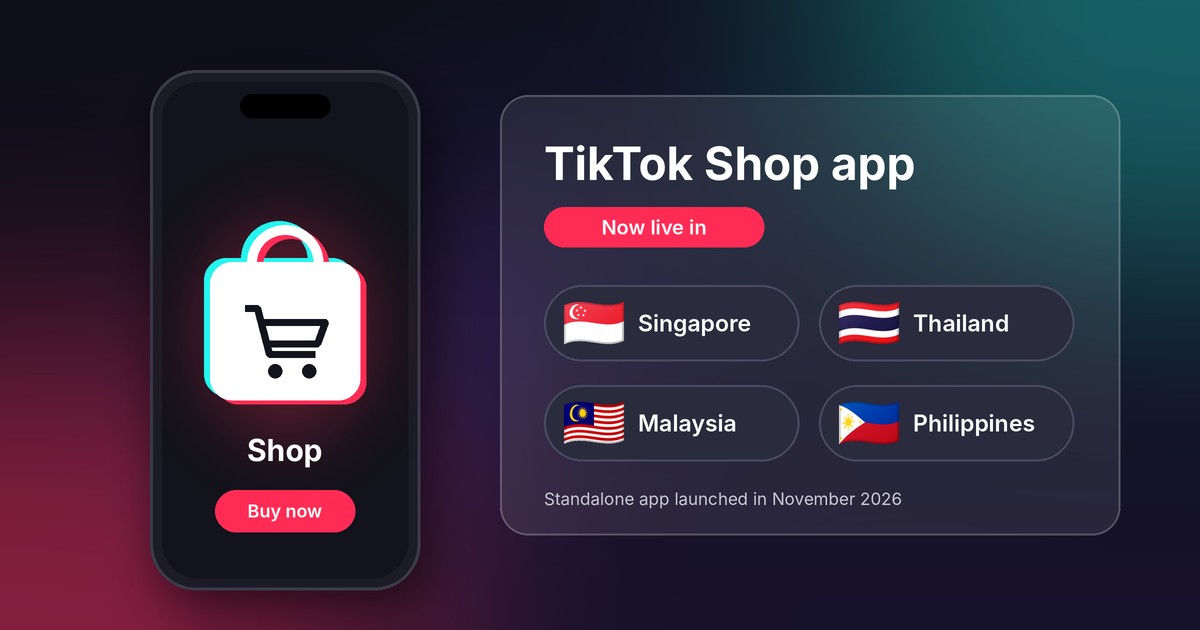
On 5 November 2026, TechCrunch reported that TikTok had launched a standalone TikTok Shop app on iOS and Android in Singapore, Malaysia, Thailand and the Philippines. It offers personalised recommendations, shopping through short videos and livestreams, in-app checkout, order tracking and app-exclusive deals. TechCrunch reads it as a sign that TikTok plans to invest more heavily in social commerce. For brands, it means shoppers now have a dedicated place to browse and buy, fed by the same creator content they watch on TikTok.
YouTube: shoppable videos and creator ads
At Google Marketing Live Southeast Asia in Singapore in July 2026, Google announced video commerce tools for the region, including a way for brands to promote YouTube creators’ videos as ads in their own campaigns. Google said more than 6 million videos in Southeast Asia now carry shoppable product tags, and that total creator payouts from the YouTube Shopping affiliate programme are up more than 105% year on year. For brands, longer creator reviews and tutorials can now link straight to the product.
Meta: shopping links inside Reels
In March 2026, as reported by Engadget, Meta started letting eligible creators add clickable shopping links directly to their Reels, for up to 30 products per video, on Instagram and Facebook. For brands, a creator’s recommendation on Instagram no longer has to end with “link in bio”.
Who drives the sales
Creators who spark interest
Lifestyle, beauty, food and tech creators remain where most shoppers first meet a product. They build familiarity and trust over time, which is why the Cube Asia findings point to discovery and research as their main role. The same study notes that family and friends remain the most trusted sources, with influencers fifth, so the trust creators bring is earned through consistency and genuine use, not single posts.
Live sellers who close the sale
Alongside them, a new profession has grown fast: the live shopping host, often called a Key Opinion Seller. Their job is to sell in real time, presenting products, answering questions and keeping viewers watching through long sessions. Rest of World estimated in 2025 that Indonesia alone could have hundreds of thousands of live commerce hosts, many working from dedicated studios on commission. According to SocialDay, in Thailand nine of the top ten TikTok creators by revenue are Key Opinion Sellers.
Networks and technology that professionalise it
The ecosystem around these creators is getting organised. SocialDay reports that more than 21,000 TikTok Creator Networks worldwide support about 4.7 million TikTok LIVE creators, with Southeast Asia accounting for roughly a quarter of those networks. Technology is joining in too: Momentum Works found that in selected cases, AI-run livestreams cost about 20 to 25% of a comparable human operation while delivering around 80% of the sales per hour.
How to build your social commerce strategy for 2027
Here is how we would approach it with a brand selling in Southeast Asia.
1. Choose your platforms by market and category
TikTok, YouTube, Instagram and Facebook each play a different role, and their shopping features vary by market. Start from where your audience spends time and where your category sells, rather than trying to be everywhere at once.
2. Mix your creator profiles
Plan for different kinds of creator talent: lifestyle creators and experts who build interest and credibility, and, where it fits your category, live sellers who specialise in converting it. Each has its own brief, its own metrics and its own way of working.
3. Keep an awareness layer to create demand
Momentum Works warns that brands may over-invest in live and under-fund the affiliate, short video and review content that often drives demand. Shoppable links and live sessions convert interest that already exists, so keep creators in the plan whose job is to make your brand familiar. This is where always-on creator programmes pay off: the more often an audience sees creators they follow recommend a brand, the more natural it feels to buy when a link or a live session appears.
4. Amplify the content that works
Use your first wave of content to learn which creators, hooks and formats your audience responds to, agree usage rights, then boost the best with TikTok Spark Ads and Meta partnership ads on Instagram and Facebook. For SharkNinja in the Philippines, we ran 7 campaigns across 6 products with 80 creators, producing 97 pieces of content that generated 3.4M organic views, and 86.1M paid views once the best content was amplified.
5. Switch on shopping features where they fit
Add product tags on TikTok and YouTube, shopping links in Reels, and live sessions where your category and market support them. Make the path from video to checkout as short as possible.
6. Measure from view to sale, and disclose clearly
Track each stage, from views and engagement to clicks and sales, using one tracking device per campaign written into every brief. Paid or gifted content must be clearly disclosed with #ad or the paid partnership label, and we recommend placing it at the start of the caption.
Where Narrators comes in
We help brands across Singapore, Malaysia, Indonesia, Thailand, Vietnam and the Philippines build the creator side of social commerce: finding the right creators for each market, running the campaigns that build familiarity and trust, and identifying the content worth amplifying and making shoppable. If you are planning your social commerce strategy for 2027, talk to our team.
FAQ
What is social commerce?
Social commerce is buying and selling through social and video platforms, where people discover a product in a creator’s video, livestream or post and, increasingly, buy it without leaving the app.
What is a Key Opinion Seller?
A Key Opinion Seller is a creator whose focus is selling rather than building reach, typically through live shopping sessions and affiliate links. In markets like Thailand and Indonesia, they have become an important part of how products are sold on social platforms.
Is the TikTok Shop app available in every Southeast Asian market?
As reported in November 2026, the standalone TikTok Shop app launched in Singapore, Malaysia, Thailand and the Philippines. TikTok had not announced a wider rollout at the time of reporting.
Do brands still need awareness campaigns now that creator content is shoppable?
Yes. Shoppable features make buying easier, but research from Cube Asia shows creators in the region mainly influence purchases by sparking interest. Awareness campaigns build that interest and help you find the creators and content worth using in conversion campaigns.